
Syzygium cordatum – Umdoni or Waterberry
This water-loving tree is often found near streams or swampy areas.
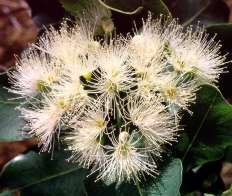
The flowers are rich in nectar and will attract a host of bees, butterflies, birds and other insects to your garden; which in turn will attract insect eating birds.
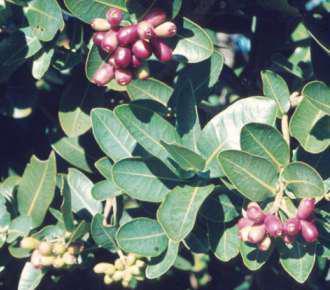
The fleshy fruit which is red to dark purple when ripe is edible, slightly acid in flavour, and is eaten by monkeys, bush-babies, bats and birds.
Description
An evergreen, water-loving tree, which grows to a height of 8 -15 m. This tree is often found near streams, on forest margins or in swampy spots. The leaves are elliptic to circular, bluish green on top and a paler green below. Young leaves are reddish. The white to pinkish fragrant flowers are borne in branched terminals and have numerous fluffy stamens and produce abundant nectar. It flowers from August to November. The fruits are oval berries, red to dark-purple when ripe.
Conservation Status
Least Concern (LC), this species is not threatened.
Distribution and habitat
Syzygium cordatum occurs along streambanks from the Eastern Cape through KwaZulu-Natal and northwards to Mozambique. It grows in forest margins, in bush, in riverine thicket and forest, and in open grassy and sometimes high country. In parts of KwaZulu-Natal and Mozambique it forms stands of swamp forest.
Derivation of name and historical aspects
According to Pitman and Palmer (1972), the generic name Syzygium is based on a Greek word meaning ‘coupled’, an allusion to the paired branches and leaves.
The specific name cordatum is from the Latin word cordatus, meaning ‘heart-shaped’, referring to the shape of the base of the leaf.
Ecology
According to Palmer and Pitman (1972), one of the only two nesting sites of the Woolly-necked Stork known in South Africa is in an umdoni swamp forest near Mtunzini. The foliage of this tree is eaten by Kudu and birds such as the Crowned Hornbill feed off the large hairy caterpillars that sometimes infest the tree.
Uses
This tree is known for its many uses. The fleshy fruit is edible, slightly acid in flavour, and is eaten by children, monkeys, bush-babies and birds. The berries are also used to sometimes make an alcoholic drink. The powdered bark is used as a fish poison. In central Africa the tree is known as a remedy for stomach ache and diarrhoea. It is also used to treat respiratory ailments and tuberculosis.
Growing Syzygium cordatum
The tree is best grown from seed. For better germination pre-treat seed with a pre-emergance fungicide, this will prevent seedlings from dampening off before emerging above the soil. Sow seed in a seed tray filled with well-drained soil and cover seeds with a thin layer of soil. Water well and keep in a well-ventilated area. Once seed has germinated, feed seedlings with an organic liquid fertilizer. Pot seedlings into individual plant bags or pots.
As its common name suggests, this is a water-loving tree, so it is best planted in full sun near a stream or river bank or any damp area.
Above information taken from SANBI website