

Hedychium– Ginger Lilies
Ginger lilies are native to the moist tropical forests of Central and South Eastern Asia, and are classified as Category 1b highly invasive plants in South Africa.They are very attractive ornamental plants and it was for this reason that they were introduced into this country.
The plants have sticky seeds and are easily spread by birds and mammals and can remain viable for 2-4 years. Rhizomes crowd out indigenous seedlings by forming dense mats and as each rhizome adds at least one segment per season depending on climatic and light conditions, the plant can quickly colonise large untended areas.
Ginger lilies invade forests, river and stream banks, as well as moist shaded areas and pose a serious threat to our wetlands, riverine areas, biodiversity and the environment in general.
The lilies can grow as high as 2m tall and the broad bright green leaves up to 40 cm long. The flowering period is between January and April and the flowers of the 4 invasive species are different colours.


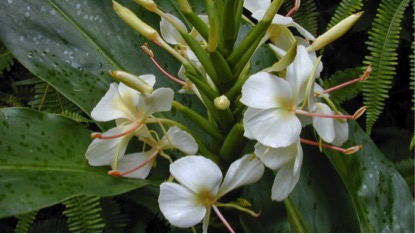
Hedychium garderianum – Kahili ginger lily has yellow flowers & red stamens and has been recognised as one of the World’s 100 Worst Invasive Alien Species. It belongs to the same family as edible ginger (Zingiber officinale), but has no culinary value.
.Hedychium coccineum – Red ginger lily has numerous red with pink protruding stamens on a raised stalk up to 350mm long appearing from January to March.
Hedychium flavescens – Yellow ginger lily.Each fragrant flower has a slender tube with three narrow and three broad, petal-like lobes. Flowers are yellow, sometimes reddish- yellow at the base.
Hedychium coronarium – White ginger lily has fragrant white butterfly like flowers. Each flower lasts a day but several hundred flowers can appear in a 6 week period
To eradicate these plants: To eradicate these plants, if there is low infestation, plants can be dug out, but care must be taken to ensure the entire rhizome is removed as even a small piece left in the ground can re-sprout.
If plants are growing in a streambed, cut the stems low down and a suitable herbicide can be painted very carefully onto the cut stump. It is advisable to use herbicides that are non-toxic and non-residual and preferably cut the Ginger lilies back in winter when the water table is low and there is less chance of herbicides being washed away or leaching into the water. Leaving the roots in place will reduce the possibility of erosion after heavy rains.
Follow up to deal with new growth will be needed.
Recent Comments